Creating an item database: Entering master data

We will discuss two approaches to entering master data (creating items), considering specific situations and how to prepare them. First, we will look at items used at the bar, then goods used in the kitchen, and separately discuss items used in both places.
We can prepare goods entry in two ways. The first is easier and faster; the second requires a little more time. The main difference between the two methods of entering goods is reflected later in the reports the program provides.
Option 1 – working with regular items (creating items)
We start by creating an item. For example, create 'Espresso coffee', which we will receive and sell by the unit. Add the item by entering only its name and selling price. Save it, and you are ready to perform all commercial operations: purchases, sales, write-offs, stocktakes and transfers. A database created this way provides information on the item's movement within the inventory account:
how many units we received into stock
how many units we sold
how many units we have written off
how many units we found during a stocktake and whether actual and expected quantities differ
how many units we transferred between warehouses, if more than one location is registered in the program
This is the faster, easier option, but it only tells us how many cups of coffee we sold, not how much coffee we purchased and sold. Items prepared this way do not show how much we spent on coffee or how much profit the product generated.
This option is suitable and convenient for clients and companies trading in goods that are received into inventory and issued from inventory without being “processed”. For example, a bottle of mineral water is received into inventory by the unit and sold by the unit. This is how clients in businesses such as alcohol and tobacco retail, building materials sales, office supplies sales and others prepare their product catalogs (create items).
Option 2 – working with composite items
We begin by preparing an item. We will use the example from option 1, but prepare it as an item with a recipe. To do this, we will create a “Coffee by the kilogram” item. This will be the item received in deliveries. Enter a name and a selling price equal to the purchase price. Change the unit of measure to “kg” (a non-count unit). This allows us to receive deliveries and use the item as an ingredient, entering quantities other than whole numbers. In the additional settings, mark the item as an ingredient and prohibited from sale. Preparing the item this way will prevent it from being sold accidentally in the future.
After preparing the ingredient item, return to the previous “Espresso coffee” item, open the “Recipe” tab and create a recipe. Select when the recipe should be executed—On sale—and begin listing the items it contains: select “Coffee by the kilogram” from the dropdown and enter its quantity. In this example, enter the quantity of “Coffee by the kilogram” to be deducted from inventory when 1 unit of “Espresso coffee” is sold, namely 0.007 kg.
Note: When creating an inventory account, the program generates two units of measure: 'pcs' and 'kg'. If you need additional units, contact our team using the email addresses on the website.
For restaurants—creating items
The next field in the recipe table is Waste. You can enter a quantity to be added to the amount specified in the preceding cell. On sale, the program adds both quantities together and deducts them from inventory. This will also increase the purchase price and sales margin.
The program also allows rows to be added to a recipe, causing several goods to be deducted in one sale. If we create Coffee with milk, its recipe will contain two rows: Coffee per kilogram and Milk per liter.
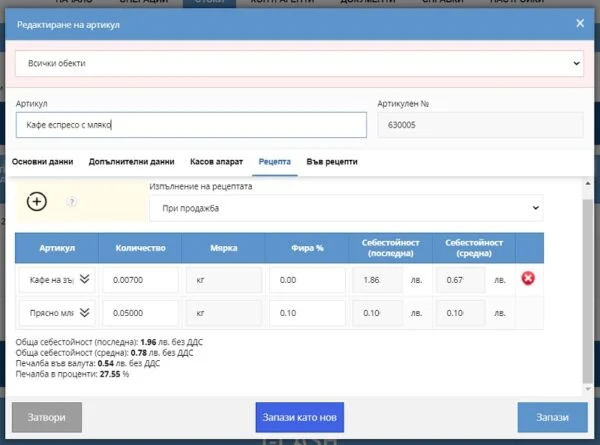
We need to prepare every item in the “Items” menu this way. First, start with a list of all ingredient items, then prepare the sale items with recipes.
This method is suitable for customers in the restaurant business and all our customers who prepare gift sets or combine several products into one.
What can we expect from the program when creating items this way?
Structuring the item database this way gives the customer more detailed reports. Items are split into two categories, allowing the customer to monitor the quantity of bulk coffee in stock, with alerts when it runs low, and also track revenue from coffee sales. Based on purchases and sales, the program also calculates profit daily, monthly and annually.
More information is available in our online guide.
Items transferred from the online store must meet certain requirements— see which.